Sunday, March 20, 2011
Honeybee Sighting Project
View Honeybee Sighting Project
Click on the above link to see the Honeybee Sighting Project in action. You will need to zoom-zoom in on the Beacon NY area.
Last Saturday was such a nice day, wasn't it?
Made all the nicer by the two honeybee sightings that I had while walking around Beacon, and the two more that I heard of from friends the next day!
I was struck by two thoughts. The first was "Where are they coming from? It was a cool enough day that the girls would not be wandering too far from home, and yet the bees that I spotted were on opposite ends of town. The second thought was how poetic it was that in spotting these bees, the three of us (myself and the other two who told me of their sightings) were linked together by the path that the bees had taken, starting from their hive and passing by us in their travels. I imagined a line drawing casting its web over the town in the form of the flight of the honeybees.
Naturally (to me at least), this got me thinking of a possible "honeybee sighting project", in which I will collect data (day, time, place) from folks who spot honey bees on any given day, and use that data to triangulate where the bees might be living, as well as illustrate the possible path that the girls might have made as they wended their way through town.
And so I invite you to let me know when you spot a honeybee. All I need is the date and location. Out of state is fine. Other countries are fine. Next door is fine.
Please note: There is NO OBLIGATION TO PARTICIPATE IN THIS. It is meant only for folks who find that the idea tickles their fancy and would like to take part.
Most likely, it will not go on indefinitely. Maybe just till the end of April, which is when we know for sure which hives have made it through the winter.


Tuesday, February 22, 2011
A Brief Reprieve

Last week the temperature rose enough for me to be able to pop the lid and take a peek into the hive. Based on the poop and smattering of dead bees in the snow, I knew that they were alive, but I did not know if they had enough stores to last them through the next two months.

After dragging a stool over to the hive and planting it somewhat firmly in the remaining two feet of snow, I popped the lid and was immediately greeted by a blanket of live, warm bees covering the tops of the frames of the upper most box. They were not nearly as happy to see me as I was to see them, but I will not take it personally.
Looking closer, I saw with great satisfaction that they still have a full super of capped honey. I closed up the hive turned to the observation tray that sits under the hive. Pulling it out, I was stunned to finds thousands of bee wings and legs. Strange enough, but stranger still is that there were no bodies. How did this happen? My only theory is this: dead/frozen bees dropped off of the cluster and onto the screen that covers the bottom of the hive. As their bodies decomposed, their wings and legs filtered through the screen, but not their bodies.

Always something new up at the hive, I say.
Tuesday, February 8, 2011
Bee Dreams

I am thankful for the warmer day or two that we have had over the past week. The long weeks of steady cold had me nervous, as the girls need days where it is over 45 degrees so that they can make their cleansing flights and rearrange the cluster. I left them with plenty of winter stores, but if they cannot get to the honey, it is of no use to them. Based on the dozen or so dead bees scattered in the snow and the brown dots of bee poop peppering the ground on the warmer days, I can safely say that there is some sort of cluster alive in there.

I had a dream last week that I was putting on a pair of black knit mittens, and something was inside the left mitten, stuck between the mitten and the back of my hand. It started crawling around in there and when it stung the back of my hand I realized that it was a honeybee. I carefully peeled off the mitten and the bee flew away. I saw that it had given me a few "warning stings", meaning that it had injected a bit of venom, but not deep enough to get her stinger caught in my skin. A few welts formed, but it was annoying more than it was painful.
When I remembered the dream the next morning, I said to Matt, "The bees were warning me about something, I have to go check on them this morning!" Then I thought to myself that this was probably a metaphorical warning, not a literal warning from the bees, but just to be sure, and even though I had just checked on the hive two days prior, I trekked up to the hive (over two feet of snow) before work.It was not until I got right up to the hive that I saw that for the first time in five years, snow had completely sealed up their entrance. I knelt down and dug out the snow and ice that was blocking their way out.
Sunday was the warmest day so far. Unable to keep away, some friends, Matt, Sam and I snowshoed past the hive on our way into the woods. A few of the girls were out, and perhaps seeing us as a warm resting post, they came over and landed on us as we walked by. I gently nudged a girl off of Shep's coat and onto my gloved fingertip. What must it be like for them, emerging from months of pitch darkness into this blinding winter landscape? Do they even see us through the glare, or do they just sense our heat and fly towards it?
As always happens this time of year, I miss them and long for the springtime when they will burst out of their hive. I am currently working on a new shadow puppet video, this one with the bees as its inspiration. The title is "When Winter Comes", in part because it would seem to me that from the day that they emerge in the spring, they are making preparations for the winter. Several months still lie between now and the first pollen of the willow tree and dandelion. My fingers are crossed.

In the meantime, here is an interesting link for those of you who are interested in some amazing footage of honey hunters. Eric Tourneret has photographed beekeeping practices around the world and here is a link to his video of honey hunting in Nepal.
Wednesday, December 1, 2010
Tucked in for the winter

Sam examining a drone evicted from the hive in the late fall
The bees are neatly tucked in for the cold season and it is now time for us to take care of our skin!
I am already slathering on the balm to ward of the cracks and dryness that accompany the chill air.
We have expanded our Beacon Bee line to include a few beautiful gift packages such as a handcrafted hardwood box filled with balm, and a cotton gift bag, also filled with balm.
You can see photos on our website under "products". You can also see our entire line in the photo below, taken at our recent sale at Boscobel.
You can now purchase Beacon Bee Balm through our website, and we recommend that you to place your orders early!
Matt, Sam and I wish all of you a peaceful and joyful holiday season.
We are thankful for all of you, and we are thankful for the bees.

Wednesday, September 29, 2010
Geniuses and Goldenrod
 Congratulations to Marla Spivak, recipient of the 2010 MacArthur Genius Grant! Spivak is an entomologist who has been doing really important research regarding honeybees and their attempts to fight all of the bad stuff that comes their way. In particular, she has been studying the hygienic practices of bees and how bees that are more hygienic are more likely to survive. Such behavior includes things like uncapping pupae that are infested with disease or mites and removing them from the hive before they are even born. I have seen this happen with my own bees and it is hard to imagine how they know how to do this, but then again it is hard to imagine how they know how to do most of the things that they do.
 And hats off as well to Carol Padden, a deaf linguist who also won the grant! Many moons ago I studied Padden's sign language books and videos and she is an amazing person. Her most recent research has involved visiting deaf Bedouins in Israel who have developed their own sign language.
Portrait of the artist as a beekeeper
Not to lump myself in with these "geniuses", but Matt did take some pretty cool photos last week up at the hive. It is amazing what a bit of smoke can do to create a mood of mystery.


The hive is doing really well. The bees are getting ready for fall/winter and I have been doing what I can to make them comfortable. The vent system is on the hive in an effort to accommodate these warm days with cold nights that can create a lot of condensation. The girls have two boxes of capped honey that I left them from the spring and summer flows. Mite levels are up, but they are kicking out the bad and taking care of the good.
 The goldenrod flow is intense this year and the hive has a heady smell that makes me lightheaded when I breath deeply. Of course, it is also making me sneeze and itch, but I don't mind, knowing that the girls are enjoying an ample fall forage. The propolis tincture is steeping and we are getting ready to dive into the world of holiday fairs. Matt has made a beautiful hardwood gift box for our Beacon Bee Body Balm, so keep us in mind when the cold wind starts to blow. For now, I am enjoying the leaves that are starting to turn, and I thank the bees for a gentle and sweet season.
Wednesday, August 4, 2010
A Swarm in July isn't Worth a Fly
This years girls are incredible. Kind, gentle, healthy and productive. Throughout the spring I had been adding supers sooner than usual in an effort to stave off swarming, and the hive quickly grew to be as tall as I am.
I thought that I had succeeded in keeping everyone at home, but the dramatic difference in what I saw upon returning from California last week told me that despite my efforts, they felt the need to divide and move on. As you can see, July 20th shows many more bees than July 31. A swarm this late in the season can mean trouble if they don't have enough time to build up their population to go into the fall with. Also, if the new queen does not take, they won't have enough time to make a new one before the fall. (Insert the sound of nails being chewed on here.) Going in this morning, my guess was confirmed. Lots of empty queen cells along the bottom edges of the frames told me that the queen has hatched and is (hopefully) in there somewhere. The earliest I can expect to see eggs or larvae would be in about a week. That would reassure me that all is well. Until then, I must sit tight and think good reproductive thoughts.
A swarm in May is worth a load of hay, a swarm in June is worth a silver spoon, a swarm in July isn't worth a fly.
It is true that July is late from a beekeepers perspective, but adding a new colony of bees to the natural world is always a good thing. If you find them in your backyard, send them my love.
July 20th
 July 31
Speaking of California, my heart leaped (no really, my heart does leap at things like this) when I saw that the feral hive in Golden Gate Park was still alive and well. (Die hard blog followers will remember these girls from last year's visit out west.) I can only hope the the girls who swarmed from my hive find as nice a home as this one.


The spring harvest was bountiful. I pulled a full box of capped honey at the end of May, which yielded about 35 pounds of flavorful honey, deep cinnamon in color. I left three more full boxes of honey on the hive, which I can pull once I know that the season is leaving them with enough for the winter.
The following images show the process of extracting the honey from the frames. I don't use a mechanical extractor because I need to save the wax for my bee balm. This "crush and strain" method is a sticky, time consuming mess, but the end result is worth it.
A full frame of capped honey

Cutting up the frame

Mashing the comb

Straining the honey

Given that it was over 100 degrees out, I thought that I might be able to melt down my beeswax using the sun rather than my stove. I have not yet made myself a solar wax melter out of the traditional materials (a wooden box lined with metal covered by a sheet of glass), so I had to make do with what I had around.


After several hours..... nothing had melted. I attracted the attention of several hundred bees though, and so I ditched the tin can and let the girls suck out what they could from the sack of wax. This ended up being a very effective way of extracting the last remnants of honey from the beeswax.

The Bee Balm King at work

Keep an eye out for notice of our new website, beaconbeebiz.com
It is not quite ready yet, but will be quite sweet when it is up and running.

I thought that I had succeeded in keeping everyone at home, but the dramatic difference in what I saw upon returning from California last week told me that despite my efforts, they felt the need to divide and move on. As you can see, July 20th shows many more bees than July 31. A swarm this late in the season can mean trouble if they don't have enough time to build up their population to go into the fall with. Also, if the new queen does not take, they won't have enough time to make a new one before the fall. (Insert the sound of nails being chewed on here.) Going in this morning, my guess was confirmed. Lots of empty queen cells along the bottom edges of the frames told me that the queen has hatched and is (hopefully) in there somewhere. The earliest I can expect to see eggs or larvae would be in about a week. That would reassure me that all is well. Until then, I must sit tight and think good reproductive thoughts.
A swarm in May is worth a load of hay, a swarm in June is worth a silver spoon, a swarm in July isn't worth a fly.
It is true that July is late from a beekeepers perspective, but adding a new colony of bees to the natural world is always a good thing. If you find them in your backyard, send them my love.
July 20th
 July 31
Speaking of California, my heart leaped (no really, my heart does leap at things like this) when I saw that the feral hive in Golden Gate Park was still alive and well. (Die hard blog followers will remember these girls from last year's visit out west.) I can only hope the the girls who swarmed from my hive find as nice a home as this one.


The spring harvest was bountiful. I pulled a full box of capped honey at the end of May, which yielded about 35 pounds of flavorful honey, deep cinnamon in color. I left three more full boxes of honey on the hive, which I can pull once I know that the season is leaving them with enough for the winter.
The following images show the process of extracting the honey from the frames. I don't use a mechanical extractor because I need to save the wax for my bee balm. This "crush and strain" method is a sticky, time consuming mess, but the end result is worth it.
A full frame of capped honey

Cutting up the frame

Mashing the comb

Straining the honey

Given that it was over 100 degrees out, I thought that I might be able to melt down my beeswax using the sun rather than my stove. I have not yet made myself a solar wax melter out of the traditional materials (a wooden box lined with metal covered by a sheet of glass), so I had to make do with what I had around.


After several hours..... nothing had melted. I attracted the attention of several hundred bees though, and so I ditched the tin can and let the girls suck out what they could from the sack of wax. This ended up being a very effective way of extracting the last remnants of honey from the beeswax.

The Bee Balm King at work

Keep an eye out for notice of our new website, beaconbeebiz.com
It is not quite ready yet, but will be quite sweet when it is up and running.
Sunday, May 16, 2010
Glory to the bees!
The girls this year are good natured and healthy. I know I am probably jinxing myself, but to have made it to mid may without a sting is a testament to their kindness.

The black locust is blooming!!
For those of you who have tasted my girls' honey, this is where the spring crop comes from! This year I have finally figured out what the black locust tree looks like and am therefore noticing them everywhere. I love this phenomena that knowledge brings. Things that were there all along, but were invisible due to not knowing what they were, suddenly become visible. For instance, this morning, Sam (for the first time) read the handwritten note posted above the doorknob on the back door that says "LOCKED" and shows a horizontal line to indicate that that is the locked position. He turned to me and said "Thanks for making this note Mama!" I explained that the note had been there for years, but that he did not know how to read it until now. Anyway... back to the black locust tree.... the honey it makes is... unbelievable. Light in color, full in flavor. It is like eating a flower. They tend (I hope, I hope) to fill a box or two the last two weeks of May. Given that everything is blooming early this year, I have been keeping a careful eye on the hive and piling on the supers.

The hive came out of winter in fine shape and needed a second super by the end of April. I have been debating whether or not to follow through on my plan to split this hive so that I can regain a second hive after my winter loss. Two weeks ago they had brood up through the first super, leading me to believe that they would be booming enough to split without a problem. Today, that top super was full of nectar and the brood was all within the two deeps. I think I am best off leaving well enough alone. I will keep my eyes and ears out for a swarm to adopt, but otherwise will stick with this one (hopefully) healthy and strong hive.

This is me bee gazing about a month ago as the girls started their spring forage in earnest.

And here is a closer look at a joy flight, or play flight, or orientation flight. This occurs when the girls graduate to their last job of "forager". They will spend a few minutes hovering in front of the hive, moving up and down, up and down, getting used to the smell, sight and location of their home so that they know where to come back to after foraging far and wide.

In anticipation of the upcoming flow, I added an empty super two weeks ago. This is a frame that the girls are in the process of drawing comb on. Isn't it lovely? Giving them a foundationless frame allows the girls to decide what kind of comb they want to draw, worker brood (smallest), drone brood or cells for honey storage. By next week, this will be a full frame of comb, most likely filled with nectar.

I added a third super after my last inspection. I left feeling very anxious because I was not able to see any worker brood, larvae or eggs, but I did not go very far into the brood chambers because by that time the girls had had enough of me and were getting pissy. What I did see was nicely patterned drone brood and some empty frames. My first thought was "No queen!" (a queenless hive can develop laying workers who can grow drones but not worker bees), but the empty frames could have been recently vacated by the last batch of workers, and it is natural that the queen would be making lots of drones right now, especially if there is any chance of swarming in their future. I am painfully aware that I do more harm than good whenever I go into the hive, so I will keep my fingers and toes crossed and try to let them do their work in peace.

The black locust is blooming!!
For those of you who have tasted my girls' honey, this is where the spring crop comes from! This year I have finally figured out what the black locust tree looks like and am therefore noticing them everywhere. I love this phenomena that knowledge brings. Things that were there all along, but were invisible due to not knowing what they were, suddenly become visible. For instance, this morning, Sam (for the first time) read the handwritten note posted above the doorknob on the back door that says "LOCKED" and shows a horizontal line to indicate that that is the locked position. He turned to me and said "Thanks for making this note Mama!" I explained that the note had been there for years, but that he did not know how to read it until now. Anyway... back to the black locust tree.... the honey it makes is... unbelievable. Light in color, full in flavor. It is like eating a flower. They tend (I hope, I hope) to fill a box or two the last two weeks of May. Given that everything is blooming early this year, I have been keeping a careful eye on the hive and piling on the supers.

The hive came out of winter in fine shape and needed a second super by the end of April. I have been debating whether or not to follow through on my plan to split this hive so that I can regain a second hive after my winter loss. Two weeks ago they had brood up through the first super, leading me to believe that they would be booming enough to split without a problem. Today, that top super was full of nectar and the brood was all within the two deeps. I think I am best off leaving well enough alone. I will keep my eyes and ears out for a swarm to adopt, but otherwise will stick with this one (hopefully) healthy and strong hive.

This is me bee gazing about a month ago as the girls started their spring forage in earnest.
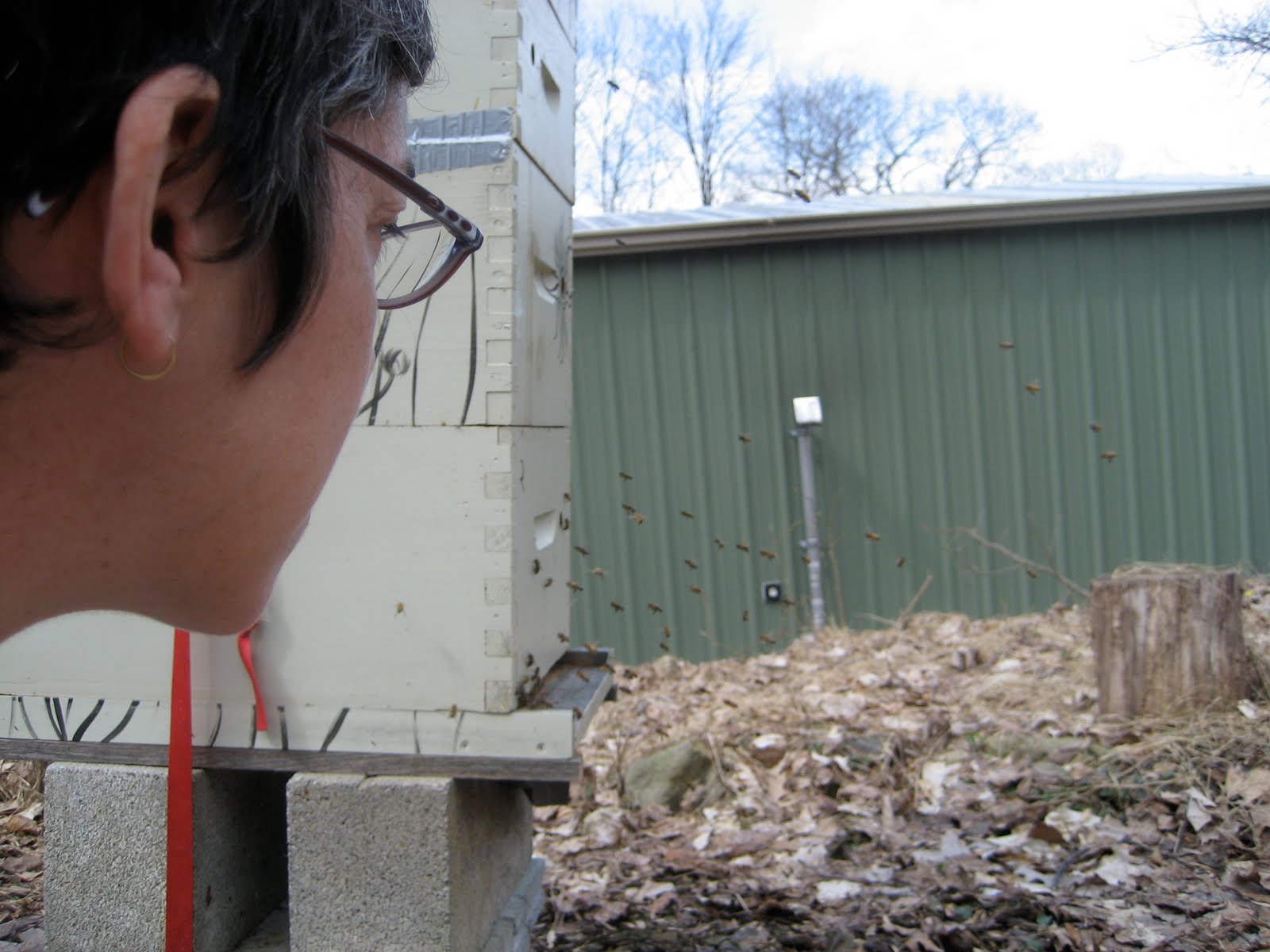
And here is a closer look at a joy flight, or play flight, or orientation flight. This occurs when the girls graduate to their last job of "forager". They will spend a few minutes hovering in front of the hive, moving up and down, up and down, getting used to the smell, sight and location of their home so that they know where to come back to after foraging far and wide.

In anticipation of the upcoming flow, I added an empty super two weeks ago. This is a frame that the girls are in the process of drawing comb on. Isn't it lovely? Giving them a foundationless frame allows the girls to decide what kind of comb they want to draw, worker brood (smallest), drone brood or cells for honey storage. By next week, this will be a full frame of comb, most likely filled with nectar.

I added a third super after my last inspection. I left feeling very anxious because I was not able to see any worker brood, larvae or eggs, but I did not go very far into the brood chambers because by that time the girls had had enough of me and were getting pissy. What I did see was nicely patterned drone brood and some empty frames. My first thought was "No queen!" (a queenless hive can develop laying workers who can grow drones but not worker bees), but the empty frames could have been recently vacated by the last batch of workers, and it is natural that the queen would be making lots of drones right now, especially if there is any chance of swarming in their future. I am painfully aware that I do more harm than good whenever I go into the hive, so I will keep my fingers and toes crossed and try to let them do their work in peace.
Subscribe to:
Posts (Atom)

